





When water treatment in building services is discussed, many people first think of heating systems. Yet cooling water quality is at least equally important in commercial and industrial applications – and is often neglected much more frequently in practice.
Whether in data centres, production facilities, hospitals or office complexes with air-conditioning systems: Wherever cooling circuits are in operation, water quality has a direct impact on the efficiency, operational reliability and service life of the entire system. For several years now, VDI 6044 has provided clear guidelines defining these requirements – making it increasingly important reading for HVAC professionals, planners and system operators.
Why cooling water has different requirements than heating water
At first glance, heating circuits and closed cooling circuits may appear to work in a similar way: both use water as a heat-transfer medium and rely on heat exchangers and pumps. In practice, however, the requirements for water quality differ considerably.
Cooling systems often operate at lower temperatures than heating systems – and this is precisely why VDI 6044 applies to closed cooling circuits with temperatures of up to 40 °C. This may sound harmless at first, but it has consequences: Lower temperatures can promote microbiological growth. Biofilm, algae and bacteria can colonise areas with low flow and form deposits that impair heat transfer and accelerate corrosion processes.
At the same time, cooling systems in industrial applications are often larger than typical heating systems, contain a complex mix of materials and may operate continuously. This means that even minor deviations in pH value, conductivity or hardness can develop into serious problems over time.
What VDI 6044 requires
VDI 6044 defines guideline values for water quality in closed cooling circuits. In many respects, it is based on the familiar parameters of VDI 2035, while extending them with requirements specific to cooling water.
Key parameters include pH value, total hardness, electrical conductivity, chloride and sulphate content, iron content and TOC (Total Organic Carbon) as an indicator of organic contamination. In addition, VDI 6044 requires a water-chemical analysis of the fill water before commissioning as well as regular monitoring of the circulating water.
For HVAC contractors and planners, this means that cooling water treatment is no longer simply a “nice-to-have”. It is a requirement established by a technical guideline that must be taken into account during system planning, initial filling and ongoing operation.
The challenge in practice
In theory, the requirements of VDI 6044 are clearly defined. In practice, however, planners and operators frequently face specific challenges.
Cooling systems in commercial and industrial buildings often have large system volumes. Initial filling and subsequent make-up water require treatment capacities that can only be covered to a limited extent with mobile equipment. At the same time, operators increasingly expect continuous monitoring of water quality – not just during annual maintenance, but throughout ongoing operation.
Another factor is that industrial cooling circuits often operate around the clock, and failures can have direct economic consequences. An unplanned shutdown in a data centre or production facility can result in enormous costs within just a few hours. This makes operational reliability a decisive factor – and water quality a fundamental prerequisite.
Stationary treatment: The solution for large and critical systems
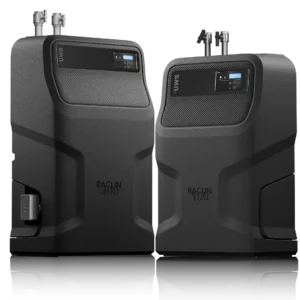
The Racun series was developed specifically for these requirements. As a stationary water treatment solution, Racun is designed for continuous operation in larger cooling and heating systems and provides fully automatic water treatment directly within the system.
Racun operates continuously and independently monitors water quality. If values deviate from the defined target range, it automatically takes corrective action – without manual intervention and without interrupting operation. This makes it an ideal solution for facilities where reliability and availability are top priorities.
Combined with the UWS Cloudportal, all relevant data – including water parameters, make-up volumes and system status – can be accessed remotely at any time. Planners, operators and maintenance contractors therefore have access to a shared data basis that creates transparency and significantly simplifies documentation in accordance with VDI 6044.
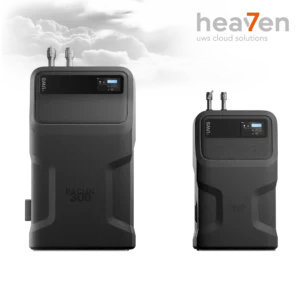
Racun 100 / 300
The Racun range comprises water treatment systems that reliably maintain stable water quality even in complex and highly sensitive systems. Wherever failures can have serious consequences – in industrial facilities, hospitals, local heating networks or data centres – Racun provides a level of protection designed to meet the highest demands.Go to the product
Treatment and filtration in a single step
One of the key advantages of Racun is its integrated fine and magnetite filter. This combines water treatment and particle filtration in a single system – without additional components or separate installation work. Corrosion products, magnetite and fine particles are continuously removed from the cooling water while the water chemistry is monitored and controlled at the same time.
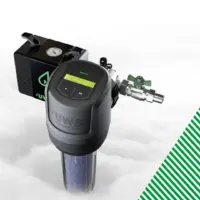
For existing systems that are not equipped with Racun, filtration can also be implemented retrospectively as a standalone measure. The MAGella Side Stream Filter is installed in parallel with the main circuit and continuously filters magnetite and solid particles from the system water via a side stream – without affecting the main flow rate and without requiring the system to be shut down.
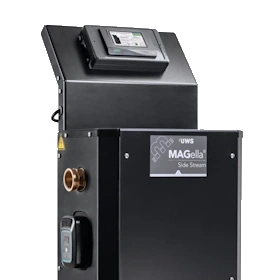
MAGella Side Stream Filter
The MAGella Side Stream Filter is a filter unit for continuous water filtration in cooling and heating systems using a bypass configuration.Go to the product
Installed directly in the main flow, MAGella magnetite separators provide additional protection by specifically removing magnetic particles from the system water, helping to protect sensitive components such as heat exchangers and control valves over the long term.
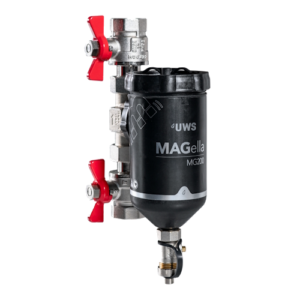
MAGella MG
The MAGella MG 200 magnetite and dirt separator, installed in the return line at the boiler, protects the system against all types of contamination.Go to the product
Water analysis and documentation
VDI 6044 requires water-chemical analysis before commissioning and during ongoing operation. For on-site analysis, the WaterBoy measuring case provides all the necessary measuring instruments for determining the relevant parameters – including documentation via the WaterBoy app.
Combined with the UWS Cloud Portal, this creates a complete documentation chain: From initial filling and regular monitoring through to make-up water, all relevant data is recorded centrally and can be accessed at any time. This not only makes compliance with VDI 6044 easier, but also provides a reliable basis for maintenance agreements and operator responsibilities.
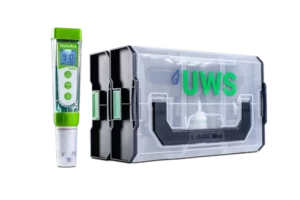
WaterBoy measuring case
The UWS WaterBoy measuring case contains everything HVAC professionals need in two L-BOXX cases to measure data in accordance with VDI 2035, ÖNORM H 5195-1 and SWKI BT 102-01.Go to the product
Conclusion
Cooling water treatment in commercial and industrial applications is no longer a peripheral issue. With VDI 6044, clear requirements exist for water quality in closed cooling circuits – and responsibility for meeting them lies equally with planners, installers and system operators.
With stationary treatment solutions such as the Racun range, targeted filtration in both the side stream and main flow, and compliant water analysis, stable water quality can also be maintained in demanding cooling systems over the long term. This helps ensure operational reliability, efficiency and system service life – while reliably meeting the requirements of VDI 6044.