



What is mixed bed resin and why is it so important?

A mixed bed resin is a combination of cation exchange resins and anion exchange resins. It removes almost all dissolved salts from the water and reduces the electrical conductivity to a minimum. As a result, limescale deposits or corrosive processes no longer occur in the heating system.

One cubic meter of water with 17 °dH contains around 300 g of limescale. Even in a detached house with just 350 liters of filling water, 100 g of limescale can build up in the heat exchanger – enough to cause expensive damage.

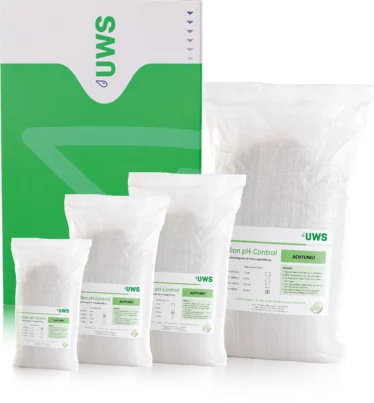
Fully demineralised water Vadion pH-Control mixed-bed resin

In order to meet the values recommended in VDI 2035 (hardness of 0.11 °dH, ≤ 100 μS/cm, pH of 8.2–10 in stainless steel systems or 8.2–9 for aluminium components), we have developed a special mixed-bed resin.

Our Vadion pH-Control is a mixed-bed resin which, in addition to demineralising the water to < 100 μS/cm (equivalent to 0–2 °dH), also ensures that the pH value of the heating water falls within the required range. It can be used at water temperatures ranging from 3 to 80 °C. This also enables the removal of residual hardness and dissolved salts from the heating water in a heating system via a bypass system.

Not all mixed-bed resins are the same

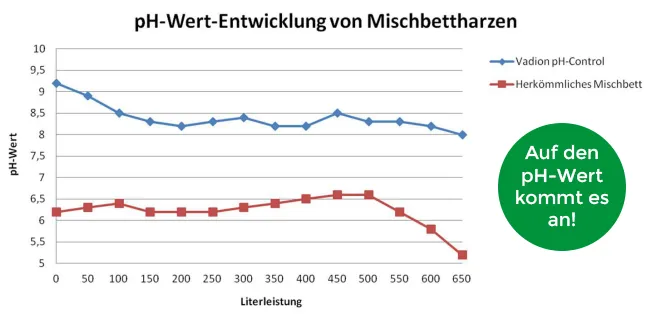
Many rival resins perform well in terms of desalination in the short term. But the real problem arises later: the pH level drops, the water becomes corrosive, and suddenly damage occurs to heat exchangers, pumps or pipework.

With Vadion pH-Control, this does not happen. This is because our mixed-bed resin is a specially developed blend that achieves three things simultaneously: optimal desalination, water hardness and stable pH values within the standard range.

The performance curves are based on the results of a laboratory test. In practice, variations may occur due to water quality.

Advantages of our mixed bed resin at a glance:

Effective demineralization – removes ions that lead to limescale, corrosion or conductivity problems
Optimized pH value – automatically sets the correct pH value for heating water
Environmentally friendly – no chemical additives, easy disposal with household waste
Ready for immediate use – ideal for mobile desalination units and filling stations
Compact & reliable – particularly suitable for the HVAC sector and domestic installations
Complies with standards – Meets VDI 2035, ÖNORM H 5195-1 and SWKI BT 102-1

Areas of application of Vadion pH-Control:

Filling and topping up heating systems
Use in mobile mixed-bed cartridges
Application range from 3 to 80 °C water temperature
Protection of heat pumps, condensing boilers & solar systems
Retrofitting in existing or new buildings
Can also be used in bypass mode

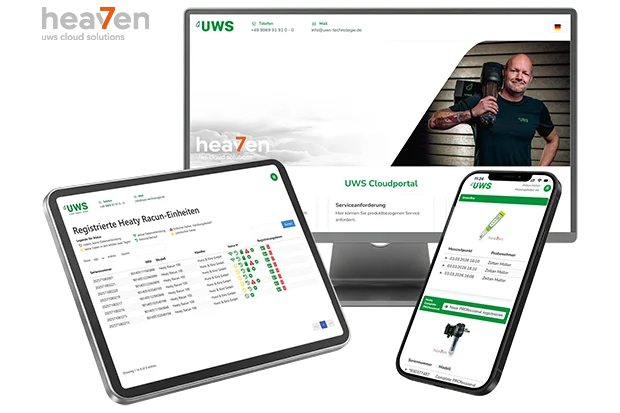
Heaven7 - UWS Cloud Portal

A new approach to digital system monitoring.

The UWS Cloud Portal brings together system information, measurement logs and system messages on a single central platform for the first time.

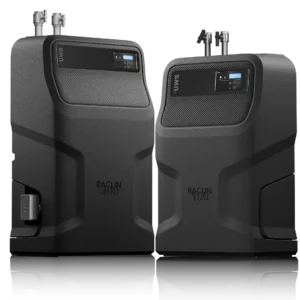
All data from the WaterBoy App is automatically documented in accordance with standards and can be accessed at any time. At the same time, intelligent Heaven7 devices such as the Racun series or replenishment solutions such as the Heaty Complete PROfessional deliver important information directly to the cloud – for example, in the event of leaks or when Vadion pH-Control mixed-bed resin has been used up.

This creates digital documentation of system statuses and operating data – clear, structured and available at any time.

measure – treat – replenish – document

One platform. All information. Maximum transparency.

FAQ on mixed-bed resin and Vadion pH-Control

How long does the mixed bed resin last?

This depends on the water consumption and the water hardness. At 10 °dH, 1 liter of resin is sufficient for about 100 liters of demineralized water.

Can I use Vadion pH-Control in any heating system?

Yes – it can be used universally, even with sensitive systems such as heat pumps or condensing boilers.

How do I know when the resin is exhausted?

The conductivity of the water increases – a digital measuring device such as the UWS WaterBoy indicates this reliably.