


Top 10 mistakes when filling the heating system with water – and how to avoid them in the long term
Filling the heating system with water is not a minor step – it is the starting point for the entire system life cycle.
Nevertheless, it is often carried out under time pressure, simplified, or done “as usual.”.
The problem with this is that
errors in filling do not have a short-term effect – they have an impact for years.
Below you will find the ten most common mistakes when filling heating water – with detailed explanations and clear solutions from practice.
1. Filling with untreated tap water without subsequent treatment
Tap water is a high-quality foodstuff, but it is not a suitable operating medium for heating systems.
It contains hardness minerals, dissolved salts, and ions, the composition of which varies greatly from region to region and is not tailored to the requirements of technical systems.
In practice, filling with drinking water is not unusual at first.
However, it becomes critical if this water is not then specifically treated.
This is because untreated tap water:
- has high conductivity
- promotes electrochemical corrosion processes
- promotes the formation of limescale, sludge, and magnetite
Once introduced into the system and left untreated, these substances remain in the system permanently and continue to have an effect for years.
How to avoid this mistake:
If a heating system is filled with drinking water, immediately followed by targeted treatment – for example, using a bypass solution with Heaty Ferriline No. 2.
This involves treating the heating water in the circuit, for example by desalinating and stabilizing the water chemistry, until the required target values are reached.
This turns a pure drinking water filling into a controlled, professional filling process that creates the basis for long-term, safe, and guideline-compliant system operation.
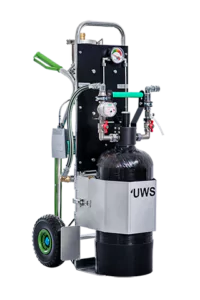
Heaty Ferriline No. 2
Complete unit for professional bypass treatment, sludge and magnetite filtration in the hot water area incl. MAGella twisterTo the product
2. VDI 2035 is mentioned – but not implemented
VDI 2035 is familiar to many, is mentioned in quotations and referred to in discussions.
In practice, however, it often remains a formal reference.
Typical weak points:
- No concrete measurement of water values
- No evaluation of the results
- No documentation
This means that the guideline is not actually implemented – and offers no protection whatsoever.
How to avoid this mistake:
Understand VDI 2035 for what it is:
a technical guideline that must be actively applied.
Compliance with the guideline means:
- measuring
- Evaluate and, if necessary,. Take action
- document
3. No analysis of the source water
Many filling processes are started without prior analysis of the water used.
This leaves it unclear:
- what the conductivity is
- what salt load is introduced
- whether the water is even suitable
Without this information, there is no technical basis for the process.
How to avoid this mistake:
Analyze the source water before each filling—regardless of whether it will be treated later.
This is the only way to realistically assess quality, effort, and capacity.
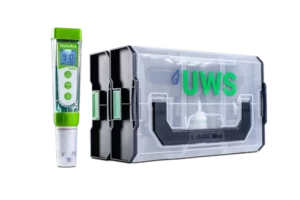
Messkoffer WaterBoy
The UWS WaterBoy measuring case contains everything the HVAC specialist needs to measure data in accordance with the VDI 2035, ÖNORM H 5195-1 and SWKI BT 102-01 standards in two L-BOXXES.To the product
4. No analysis after filling
Even if treatment is carried out, the final check is often missing.
Without measurement after filling, no one knows:
- whether the target values were achieved
- whether the treatment was complete
- the condition in which the system was handed over
This is particularly critical in the event of subsequent damage.
How to avoid this mistake:
Always perform and document a heating water analysis after filling.
This is the technical and legal handover point.
5. Replenishment is considered an exception
In theory, the heating system is sealed.
In practice, top-ups are carried out regularly throughout the entire service life of the system.
Typical causes are
- Venting processes after commissioning or maintenance
- Service and repair work
- Small, often unnoticed water losses in the system
Jede einzelne Nachspeisung bringt neues Wasser in den Heizkreis und verändert damit zwangsläufig die Wasserchemie.
Leitfähigkeit steigt, der pH-Wert kann sich verschieben und korrosionsfördernde Stoffe gelangen erneut ins System.
Gerade bei wiederholter Nachspeisung verliert selbst eine sauber durchgeführte Erstbefüllung langfristig ihre Wirkung.
How to avoid this mistake:
Refilling must be planned as an integral part of the water concept from the outset – not as an exception.
With a permanently integrated solution such as Heaty Complete PROfessional, every top-up is automatically treated. The heating water is specifically desalinated and the pH value stabilized before it enters the system.
In addition, the system continuously monitors the make-up process.
In the event of unusually high water demand – for example, as a result of a leak – Heaty Complete PROfessional issues a warning and automatically interrupts the make-up water supply.
This reliably prevents uncontrolled replenishment, creeping water loss, and possible water damage.
Make-up water is thus transformed from a risk into a controlled, safe, and monitored process – technically clean and practical for real plant operation.
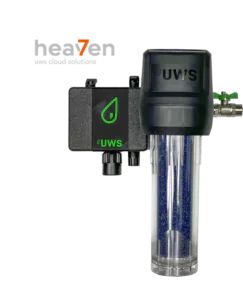
Heaty Complete Professional
Heaty Complete PROfessional is the world’s first smart IoT make-up system, including Cloud connection – fully automatic, leakage protection and digital water meter.To the product
6. Treatment systems are too small
A common practical error is undersizing the water treatment system.
The system is just sufficient for the initial filling – but not for:
- larger system volumes
- subsequent make-up quantities
- long-term operation
The result: water that appears to be clean but does not maintain the target values in the long term.
How to avoid this mistake:
Always base treatment on the actual system volume and life cycle – not the minimum requirements.
7. The material mix of the system is not taken into account
Modern systems are complex in terms of materials:
- Steel pipes
- Copper components
- aluminum heat exchangers
- composite and plastic systems
Without coordinated water quality, the following occur:
- electrochemical stresses
- selective corrosion
- premature component wear
How to avoid this problem:
Always check the pH value and conductivity material-dependent and monitor them.
Flat-rate target values do not work here.
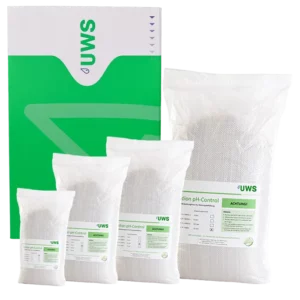
Mischbettharz Vadion pH Control
Our Vadion pH-Control is a mixed bed resin that not only desalinates the water to < 100 μS/cm (equivalent to 0-2 °fh) but also ensures that the pH value of the filling water is within the required range.To the product
8. Oxygen ingress is underestimated
Oxygen is one of the strongest drivers of corrosion in heating systems.
It enters the system through:
- Filling
- Make-up
- Leaks
- Open system areas
Even small amounts can cause long-term damage.
How to avoid this mistake:
- controlled filling
- Minimized replenishment
- Regular leak testing
Oxygen management is a silent but crucial factor.
9. Magnetite formation is only detected when damage occurs
Magnetite does not form suddenly, but gradually over months and years.
It is the result of ongoing corrosion processes in the heating system and spreads unnoticed throughout the entire circuit.
By the time the first symptoms become visible, the system is often already under severe strain.
Typical consequences are:
- Clogged heat exchangers with significantly reduced heat transfer
- Blocked valves and control fittings
- Increased wear or failure of pumps
- Declining efficiency and increasing energy consumption
Magnetite does not act selectively, but system-wide. If it is not removed at an early stage, it increases corrosion, deteriorates water quality, and accelerates the aging process of the entire system.
How to avoid this mistake:
Magnetite separation must be planned for from the outset – as preventive protection, not just as a reaction to damage.
High-performance magnetite separators such as the MAGella MG 200 continuously remove magnetic particles from the heating water before they reach sensitive components.
This keeps the system hydraulically stable, protects heat exchangers and pumps, and maintains efficiency in the long term.
Magnetite separation is therefore not an additional component, but a fundamental part of modern corrosion prevention.
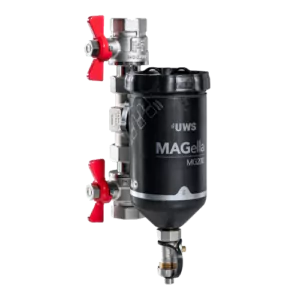
MAGella MG 200
The MAGella MG 200 magnetite and sludge separator mounted on the return pipe of the boiler protects the system from all types of contamination.To the product
10. Missing or incomplete documentation
Without documentation, there is no proof of:
- a filling in accordance with guidelines
- a correct heating water quality
- a professional, traceable procedure
What is often perceived as a formal step in everyday life quickly takes on a completely different meaning in the event of damage.
If it cannot be proven in what condition the system was handed over, a technical issue quickly becomes a liability and evidence problem.
Especially in cases of corrosion damage, magnetite formation, or efficiency losses, the crucial question is often:
Was the heating water correctly tested and documented?
Without reliable documentation, this question remains unanswered – usually at the expense of the company carrying out the work.
How to avoid this mistake:
Documentation must be an integral part of the work process, not something that is rushed at the end under time pressure.
These include:
These include:
- Complete recording of all relevant measured values (e.g., pH value and conductivity)
- Documentation of filling and replenishment
- A clear, comprehensible handover to the operator
With a measuring device such as the WaterBoy, heating water analyses can not only be carried out reliably, but also documented in a structured manner.
The measured values are recorded in a reproducible manner and compiled in a clear report that can be handed over to the operator and archived permanently.
This means that the measurement provides reliable evidence – technically sound, transparent, and legally secure.
Documentation is therefore not an additional bureaucratic burden, but a central component of professional heating water treatment.
It protects not only the system, but also the specialist company.
Heating water filling is a quality process
Experience from numerous projects at UWS Technologie clearly shows:
Many subsequent damages are not operating errors, but start-up errors.
Clean filling:
- creates stable water quality
- reduces maintenance and repair costs
- minimizes liability risks
- increases the service life of the system
Conclusion: Those who save on filling will pay twice later
Heating water filling is not a formal act – it is the technical basis for system operation.
Careful planning, measurement, and documentation will prevent most problems later on from day one.
Heating water filling in accordance with guidelines is not an additional expense – it is a professional responsibility.


 Contact us