


Heating water – reverse osmosis compared to resin treatment
The treatment of heating water is crucial for the service life of modern heating systems. But which method is the better choice in practice – reverse osmosis or resin treatment? This article examines both methods, highlights their advantages and disadvantages, and provides practical recommendations for HVAC professionals.
What is the goal of heating water treatment?
The goal is always the same: chemically stable heating water that prevents corrosion, avoids deposits, and meets the requirements of VDI 2035, ÖNORM H 5195-1 and SWKI BT 102-01.
The following factors are crucial for this:
- conductivity
- pH level
- Removal of hardness minerals and corrosive salts (e.g., chlorides, sulfates)
But what is the most efficient way to achieve this water quality – with reverse osmosis or resin treatment?
Reverse osmosis in heating water – membrane technology with limitations
How it works
Reverse osmosis (RO) works with a semi-permeable membrane that retains salts and hardness-forming substances. This produces high-purity water with low conductivity.
Advantages
- Very low conductivities possible (< 10 µS/cm)
- Continuous operation with large quantities of water possible
- No consumables except the membrane
Disadvantages
- High installation and investment costs
– even the replacement membrane costs around €750 per unit - Wastewater (concentrate)
– depending on the system, the ratio of treated water to wastewater is at least 3:1, and in some cases even 1:1
– A significant proportion of the water must be disposed of as grey water. In addition to the environmental aspect, disposal incurs further costs - Actual performance often significantly lower than stated
– In practice, many devices deliver not the maximum specified 300 l/h, which increases the working time - Permeate pH unstable → Post-treatment necessary – This means additional costs and, if necessary, the use of chemicals to adjust the pH value
- RO can only fill – not clean
– Existing sludge, magnetite, or corrosion particles remain in the system
– Classic flushing according to EN 14336 is required
– additional costs + possible loss of time - Risk of leaks
– Expensive low-salt water would flow directly into the sewer system
– Additional costs and customer dissatisfaction guaranteed
👉 Assessment:
Suitable for large stationary systems – but often too slow for everyday use in HVAC inefficient, too complex and too labor-intensive.
Resin processing – the practical standard
How it works
Resin treatment with mixed-bed resin uses ion exchangers that replace all salts with H⁺ and OH⁻ . Result: low-salt, chemically stable water.
Advantages
- Compact and mobile
- Standard-compliant heating water in a short time
- No wastewater problems
- Stable pH values with Vadion pH-Control
- 50% reduction in working time compared to RO systems
– because actual flow rates are significantly higher - Ideal for initial filling and top-up
- Safe in the event of leaks
– no expensive permeate is lost
Disadvantages
- Cartridges must be regenerated or replaced
- More cost-intensive than RO for very large quantities of water
👉 Assessment: The optimal solution for mobile filling, service work, existing systems, and make-up water.
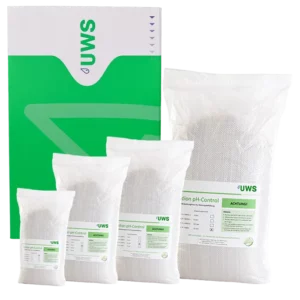
Mischbettharz Vadion pH Control
Our Vadion pH-Control is a mixed bed resin that not only desalinates the water to < 100 μS/cm (equivalent to 0-2 °fh) but also ensures that the pH value of the filling water is within the required range.To the product
UWS Heaty Ferriline / Profiline – a clear practical advantage
This is where the decisive difference to RO comes in:
1. Cleaning and filling at the same time
While UO can usually only fill, UWS Heaty Ferriline / Profiline do everything in one step:
- Rinsing
- Filtration
- Treatment
- Filling
➡️ Up to 50% more working time saved
➡️ No additional flushing required according to EN 14336
➡️ No drinking water consumption at the customer’s premises
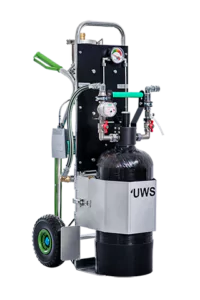
Heaty Ferriline No. 2
Complete unit for professional bypass treatment, sludge and magnetite filtration in the hot water area incl. MAGella twisterTo the product
2. Perfect for existing systems
With RO, contaminated circuits would first have to be flushed, flushed, flushed and then filled.
With our Ferriline/Profiline, everything happens in one go – and the system is immediately compliant with guidelines and standards.
3. No loss of expensive water
In the event of leaks, low-salt water runs directly into the sewer with RO.
With resin treatment, e.g., with our Ferriline / Profiline, there is no wastewater and therefore no additional costs for gray water disposal. The heating water remains completely in the system during and after treatment. And even when filling, the filling water ends up completely in the system.
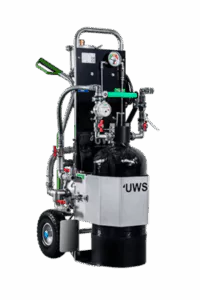
Heaty Profiline No. 2
Complete unit for professional bypass preparation, magnetite filtration and filtration incl. Hot water pumpTo the product
Normative framework – VDI, ÖNORM & SWKI
The guidelines are clear:
- VDI 2035: Heating water must be free of corrosion-promoting salts and risks of deposits.
- ÖNORM H 5195-1 & SWKI BT 102-01: specify the permissible conductivity and pH ranges.
Both reverse osmosis and resin treatment meet the requirements. In practice, the application determines the choice.
Conclusion
Reverse osmosis and resin treatment are not competitors, but two tools – albeit with very different practical applications.
While RO remains a special case, resin treatment impresses in HVAC practice with:
- faster workflows
- lower operating costs
- no wastewater problems
- standard-compliant results
- more efficient processes, especially with UWS Ferriline / Profiline and Vadion pH-Control
👉 In short: For heating engineers, resin treatment is the more economical, faster, and cleaner solution.

 Contact us