





Mixed-bed resins are among the key tools in modern heating water treatment. Yet, in practice, how they work often remains abstract. Often, only the result is considered—low conductivity, “demineralized water”—without truly understanding what happens in detail.
It’s worth taking a closer look. Because, especially when it comes to heating water treatment, understanding the processes determines how effectively and sustainably a system can be operated.
What Actually Happens During Desalination
Heating water contains—depending on the source water—a variety of dissolved substances. These include calcium, magnesium, sodium, chloride, sulfate, and many other ions. These dissolved salts are primarily responsible for electrical conductivity and play a central role in corrosion processes.
This is exactly where a mixed-bed resin comes into play. It consists of two components: a cation exchanger and an anion exchanger. Both resin types are finely mixed together in the mixed-bed and act simultaneously on the water flowing through.
During the flow, the ions dissolved in the water are selectively exchanged. Positively charged ions such as calcium or sodium are replaced by hydrogen ions, while negatively charged ions such as chloride or sulfate are replaced by hydroxide ions. These two “replacement ions” then react with each other to form pure water.
The result is water that is virtually free of dissolved salts—conductivity drops significantly. It is precisely this effect that is crucial for reducing corrosion processes in the heating system.
Why desalination alone is not enough
In practice, desalination is often viewed as the sole solution. In fact, it is a key component—but not the only one.
This is because removing the salts also alters the chemical balance of the water. In particular, the pH value can shift into a range that is not automatically optimal for all materials in the system.
This is precisely where the difference between “desalinated water” and “system-compatible heating water” becomes apparent. What matters is not only that as few ions as possible are present, but that the remaining water chemistry is stable and compatible with the materials.
The special role of the pH value in the mixed-bed process
In the context of desalination, the pH value does not arise by chance but is closely linked to ion exchange. Depending on the composition of the feed water and the condition of the resin, a slightly acidic or slightly alkaline range may result.
For heating systems, however, this is too imprecise. This is not about “just any” pH value, but rather a precisely set range that minimizes corrosion while remaining material-compatible.
This is exactly where our mixed-bed resin Vadion pH-Control comes in.
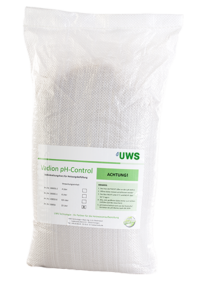
Vadion pH-Control
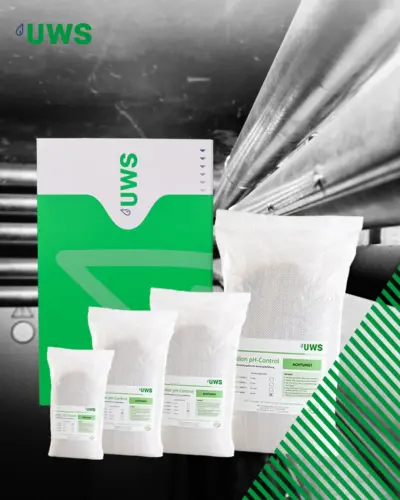
Our Vadion pH-Control is a mixed-bed resin that not only demineralizes the water to < 100 μS/cm (corresponding to 0–3 °dH), but also ensures that the pH value of the fill water remains within the required range.Go to the product
Vadion pH-Control: Desalination and pH stabilization in a single step
Unlike simple mixed-bed resins, Vadion pH-Control is not designed solely for desalination. The resin is formulated to not only reduce conductivity but also adjust the pH value to a range suitable for heating systems.
In practice, this means: While dissolved salts are removed, a stable chemical environment is created at the same time. The pH value does not settle randomly, but is specifically maintained within a range that is important for the requirements of modern heating systems.
This aspect is particularly crucial in systems with different materials. Instead of having to intervene later to correct the situation, a water condition is created during treatment that is both low in corrosion and compatible with the materials.
Practical Application
The true strength of a mixed-bed resin becomes apparent in practical use. It can be used both during initial filling and during ongoing operation.
During filling, it ensures that suitable water quality is present in the system from the very beginning. During operation, it can be used, for example, in a bypass to gradually improve existing systems. This continuously reduces dissolved substances without interrupting plant operation.
In both cases, the goal is not just clean water, but a stable system.
Why conductivity alone is not enough
A common mistake in practice is to focus exclusively on conductivity. A low value is often equated with “good water.” . However, this is too simplistic.
Only in combination with an appropriate pH value does water quality emerge that works in the long term. Water with very low mineral content can even be aggressive without a stable pH setting because protective equilibria are missing.
The combination of desalination and targeted pH stabilization is therefore crucial—and it is precisely this combination that constitutes the true added value of our Vadion pH-Control mixed-bed resin.
Conclusion: More than just “water without salts”
A mixed-bed resin is far more than just a tool for desalination. It is a key element for specifically influencing the water chemistry in the heating system.
The decisive difference lies in the details:
Not all desalinated water is automatically suitable for long-term system operation.
Only when conductivity and pH value are considered together and specifically adjusted does a condition arise that minimizes corrosion, protects materials, and maintains the system’s efficiency.
This is precisely where the practical benefits of Vadion pH-Control come into play:
It transforms “treated water” into a system medium that functions reliably over the long term.
Vadion pH-Control
Our Vadion pH-Control is a mixed-bed resin that not only demineralizes the water to < 100 μS/cm (corresponding to 0–3 °dH), but also ensures that the pH value of the fill water remains within the required range.Go to the product