


Heating water, march—but please comply with the guidelines!
What VDI 2035 really says (and how you can safely comply with it in everyday life)
If you want to operate heating systems reliably, efficiently, and without consequential damage, you need to master the topic of heating water quality. This is exactly where VDI 2035 comes in. It describes the state of the art for hot water heating systems (< 100 °C) and bundles the central requirements for filling, supplementary, and circulating water – so that limescale, corrosion, sludge, and air don’t stand a chance.
Important for classification: The currently applicable version is VDI 2035 Sheet 1 (03/2021). It combines the topics of stone formation and water-side corrosion in one document. Sheet 3 (exhaust-side corrosion) exists separately. Many industry articles casually refer to the “new VDI 2035,” even in 2023–2024, but in terms of content, they refer to the 2021 edition.
The 4 adjustment screws for heating water quality (short & sweet)
From practice for practice – that is crucial:
- Reduce hardness/lime (scale)
Target value for fill water: ≈ 0.3 °dH (soft to fully desalinated). This prevents limescale formation and keeps heat exchangers efficient. - Keep conductivity low
For low-salt operation, the guideline value in operation: ≤ 100 µS/cm – the lower, the better against corrosion. - Adjust the pH value appropriately
General: 8.2–10.0
With aluminum components: 8.2–9.0 (drive more carefully, otherwise aluminum will corrode). Only evaluate pH after the running-in phase (8–12 weeks). - Avoid oxygen
Oxygen accelerates corrosion. Guideline values in practical literature: < 0.1 mg/l for low-salt operation; often even stricter for salt-containing operation (< 0.02 mg/l). Build/maintain the system so that O₂-entry is minimal (diffusion-tight materials, tight screw connections, degassing).
Chemicals? VDI 2035 considers low-salt operation (demineralized water) to be the preferred method. Inhibitors & O₂binders increase conductivity and are exceptions, not standard.
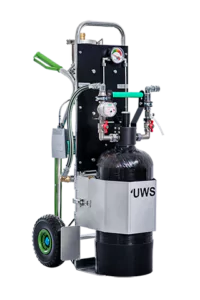
Heaty Ferriline No. 2
Complete unit for professional bypass treatment, sludge and magnetite filtration in the hot water area incl. MAGella twisterTo the product
The scope of application:
- Scope: Hot water heating systems according to DIN EN 12828 (flow < 100 °C), including hydraulically connected cooling circuits, if corrosion-resistant.
- Objective: Damage caused by lime and water-side corrosion – with clear quality requirements for filling, supplementary, and circulating water.
- Consequence: Many manufacturers link warranty conditions to verifiable compliance with VDI values.
Practical guidelines – what we aim for as an HVAC company
| Size | Target range (low salt / preferred) | Practical information |
| Hardness (fill water) | Approx. 0.3 °dH | Achieve reliably via full desalination / demineralization. |
| Conductivity (operation) | ≤ 100 µS/cm | Conductivity increases with salts, inhibitors, antifreeze; keep as low as possible. |
| pH value (without aluminum) | 8,2–10,0 | Evaluate pH after 8–12 weeks , not immediately after filling. |
| pH value (with aluminum) | 8,2–9,0 | Aluminum corrosive above ~9.0; keep tight. |
| Oxygen | < 0.1 mg/l (low salt content) | Minimize O₂e input, ensure degassing/ventilation. |
How to implement VDI 2035 – step by step
1) Inventory & planning
- Record system data: Volume, materials (aluminum yes/no), diffusion-open components, replenishment paths.
- Water analysis (filling location/raw water) + if applicable system water (if applicable).
2) Select treatment: Full desalination before softening
- Full desalination (VE/mixed bed) applies all salts → Conductivity ↓, hardness < 0.3 °dH; this is the most reliable way to achieve the VDI target values.
- Softening reduces only hardness-forming substances – the conductivity can even increase. For VDI conductivity ≦ 100 µS/cm, deionized water is the more reliable option.
3) Filling – clean, avoid air pockets
- DE filling with measuring/metering unit (conductivity, volume).
- Gently flush (existing system) until clear and free of particles. Remove magnetite and sludge from critical areas (otherwise valves, actuators, and heat exchanger channels will jam).
- Degassing / venting Consider this directly.
4) Set pH window (note material mix)
- For aluminum, consistently run at 8.2–9.0.
- Patience: pH after 8–12 weeks during operation – measurements taken before this time are not very meaningful.
5) Replenishment: only treated
- Permanent: Replenishment unit with deionized cartridge and quality monitoring; untreated water will destroy your good starting values in no time. (Chemicals only in justified exceptions.)
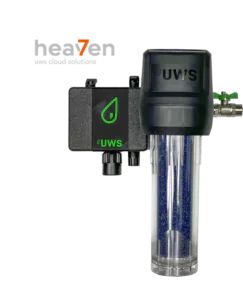
Heaty Complete Professional
Heaty Complete PROfessional is the world’s first smart IoT make-up system, including Cloud connection – fully automatic, leakage protection and digital water meter.To the product
6) Monitoring & maintenance
- Checks: Conductivity, pH, turbidity/particles, O₂ (if available).
- Documentation: Measurements, volumes, cartridge replacement, service. Manufacturer’s warranty included.
Common mistakes – and how to avoid them
- “First use distilled water, then top up with tap water.” → No-go: Values drop, corrosion sets in. Always refill with treated water.
- Check pH immediately after filling → Wait 8–12 weeks, then measure and fine-tune.
- Softened instead of deionized → Conductivity remains high/increases, corrosion risk remains. For ≤ 100 µS/cm, you need demineralization.
- Ignore aluminum → pH too high → pitting/passive layer problems. 8.2–9.0 Strictly adhere to this.
- O₂ entries via diffusion-open components/leaks → O₂ < 0.1 mg/l, plan for degassing.
Best practice: Target values that work in everyday life
- DE to ≤ 100 µS/cm (better to start lower).
- pH:
- without aluminum: 8.2–10.0
- with aluminum: 8.2–9.0
- O₂ Minimize technical factors (choice of materials, tightness, automatic degassing).
Documentation & liability – your safety net
- Handover protocol with initial values (LF, pH, hardness, turbidity), deionized water volume, filter/resin serial number, sampling point.
- Maintenance schedule with measurement intervals (e.g., semi-annually, quarterly for systems with high make-up water consumption).
- Make-up volume and quality Document continuously – many manufacturers link warranty to verifiable compliance with VDI target values.
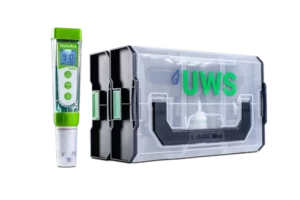
Messkoffer WaterBoy
The UWS WaterBoy measuring case contains everything the HVAC specialist needs to measure data in accordance with the VDI 2035, ÖNORM H 5195-1 and SWKI BT 102-01 standards in two L-BOXXES.To the product
FAQ
Are there fixed VDI limit values?
VDI 2035 works with guideline/target values and clear recommendations (e.g., low-salt operation). A guideline value of ≤ 100 µS/cm has been established as the target value for low-salt operation. Stricter pH ranges apply to aluminum systems.
Why VE instead of softening?
Only deionization reduces all ions → low conductivity, reduced susceptibility to corrosion. Softening only removes hardness components and can even increase conductivity.
When to measure/adjust pH?
After 8–12 weeks – the system stabilizes beforehand.
How strict is it with oxygen?
Very. < 0.1 mg/l for low-salt operation is a good target value; for salty operation, < 0.02 mg/l is sometimes mentioned. In any case, the following applies: minimize O₂e input.
Conclusion from many years of HVAC practice
If you consistently implement deionized water filling, strict makeup water control, a suitable pH range (note aluminum), and low O₂, you will safely comply with VDI 2035 – and the system will run smoothly, efficiently, and durably. The few extra minutes spent on measurement and documentation will save you days of troubleshooting and hassle with complaints later on. This is exactly how we have been doing it for years – and this is exactly how the heating water remains ready for use: clean, compliant with standards, and stress-free.


 Contact us