


Lack of Documentation for Heating Water Analysis: Why It Leads to Significant Liability Risks
In many heating projects, there is intense discussion about technology, efficiency, and eligibility for subsidies.
However, one seemingly unspectacular aspect is often underestimated:
the documentation of the heating water analysis.
If it is missing, a technically sound job can quickly turn into a legal risk.
Because without verifiable evidence, it is nearly impossible to prove that work was performed in compliance with regulations in the event of a claim.
Heating Water Analysis: A Requirement—Not an Option
Heating water analysis is not an optional extra, but an integral part of professional system installation and maintenance.
It serves to monitor key parameters such as:
- pH level
- conductivity
- the general condition of the heating water
to objectively record and evaluate.
These values are crucial for detecting corrosion risks, scale formation , and malfunctions early on or preventing them from the outset.
But here’s the key point:
A measurement alone is not enough.
Without documentation, it’s as if it weren’t done
In practice, a critical error in reasoning keeps cropping up:
“We’ve taken measurements—that’s enough, isn’t it?”
Unfortunately, from a legal standpoint, that is not the case.
What is not documented is, in case of doubt, considered not to have been performed.
If:
- corrosion damage
- Heat exchanger defects
- clogged heating circuits
- Losses in efficiency
the key question quickly arises:
Who is responsible?
Without written proof of the heating water analysis, the specialist company is often burdened with the burden of proof—and the corresponding liability risk.
Typical liability pitfalls in practice
This becomes particularly critical when:
- no measurement reports are available
- measurement values are not clearly dated or assigned
- no documented handover to the operator has taken place
- Re-injections were carried out without a new analysis
In such cases, it is difficult to prove whether:
- the system was originally filled in compliance with guidelines
- the water quality changed only later
- the operator has influenced the situation through their own interventions
The result is unclear responsibilities—and an increased liability risk for HVAC operations.
Documentation provides protection—both technically and legally
Proper heating water documentation serves several purposes.
Technically
- Proof of water quality in compliance with guidelines
- Reference values for future inspections
- A reliable basis for maintenance and service concepts
Legal
- Protection against clients and operators
- Clear delineation of responsibilities
- Solid evidence in the event of damage
In short:
Documentation is not bureaucratic red tape, but active risk protection.
Measure and document in a single step
This is precisely where the advantage of professional measurement and documentation solutions becomes apparent.
With the WaterBoy , pH and conductivity can not only be measured precisely but also documented in a structured manner.
The measured values are:
- reproducible results
- clearly organized
- recorded directly in a traceable log
- stored in the UWS Cloud Portal
This log can be handed over to the operator and permanently archived—as technical evidence and legal protection.
This turns a single measurement into a robust documentation process.
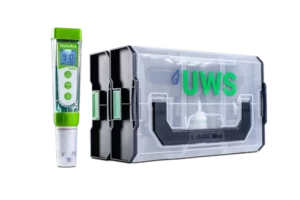
Messkoffer WaterBoy
The UWS WaterBoy measuring case contains everything the HVAC specialist needs to measure data in accordance with the VDI 2035, ÖNORM H 5195-1 and SWKI BT 102-01 standards in two L-BOXXES.To the product
Digital logs ensure reliability and transparency
Modern measurement solutions now make it possible to perform heating water analyses:
- in compliance with guidelines
- traceable
- permanently archived
and to hand them over to the operator.
For specialized companies, this means:
- fewer disputes in the event of damage
- a professional image toward customers
- a clear separation between the operator’s and the installer’s responsibilities
Documentation thus transforms from a “burdensome obligation” into a true mark of quality.
Responsibility does not end with measurement
Like all holistic concepts from UWS Technologie, professional heating water treatment does not end with the technical measure alone.
It always includes clear traceability of all relevant steps.
Only the combination of:
- proper water treatment
- regular analysis
- complete documentation
ensures the long-term safety of heating systems—both technically and legally.
Conclusion: Missing documentation costs more than just time
Those who skip documenting heating water analysis may save a few minutes in their daily routine.
In the event of damage, however, this can lead to:
- high costs
- protracted discussions
- legal disputes
.
A documented heating water analysis—supported by appropriate measurement and logging solutions—is not an extra.
It is a fundamental part of professional HVAC work and protects the system, the operator, and the service provider alike.


 Contact us