


What does conductivity mean in heating water?
Conductivity is one of the key parameters in heating water—and at the same time one of the most commonly misunderstood.
It is often viewed merely as a measured value.
A numerical value that is recorded without its actual significance for system operation being fully understood.
But there is much more to conductivity than that.
It is a direct indicator of how “active” the water in the system is—and thus how high the risk of corrosion and consequential damage is.
What conductivity actually describes
Conductivity indicates how well water can conduct electricity.
Pure water conducts almost no electricity.
It only becomes conductive through dissolved substances—especially salts.
It is precisely these dissolved ions that are crucial in the heating system.
They usually come from:
- Drinking water during initial filling
- Make-up water during operation
- Residues and reactions within the system
The more of these substances are present in the water, the higher the conductivity.
And this is precisely where the real problem begins.
Conductivity as a driver of electrochemical processes
Increased conductivity does not merely mean “more dissolved substances”.
It actively changes the conditions within the system.
This is because as conductivity increases, water becomes a better electrical conductor—and thus the basis for electrochemical reactions.
These reactions are the driving force behind corrosion.
Metals in the system interact with the water.
The better the flow of electricity, the more easily these processes can occur.
The result is gradual material degradation that develops over long periods of time.
Conductivity is therefore not a neutral measurement, but a direct factor influencing the likelihood of corrosion.
Why high conductivity is problematic
In practice, the following is repeatedly observed:
The higher the conductivity, the more unstable the system becomes.
This is because several effects occur simultaneously.
On the one hand, the likelihood of corrosion processes increases.
On the other hand, the chemical equilibrium in the water changes.
In the long term, this leads to:
- increased material dissolution
- formation of corrosion products such as magnetite
- deposits and malfunctions
The situation becomes particularly critical in systems with different materials.
Here, even moderate levels of conductivity can be sufficient to promote undesirable interactions.
The gradual increase during operation
A point that is often underestimated:
Conductivity does not remain constant.
Even if the system was initially filled correctly, the value changes during operation.
Causes of this include:
- regular makeup water
- oxygen ingress
- material reactions within the system
With each of these changes, new dissolved substances enter the water.
Conductivity increases—often unnoticed.
And just like with other processes in the heating system, this does not happen suddenly, but gradually.
The system continues to run while conditions in the background are constantly shifting.
Conductivity in the context of overall water quality
Important:
Conductivity must never be considered in isolation.
It is always related to other parameters, in particular:
- the pH value
- the materials used
- the system’s operating conditions
A specific conductivity value may be uncritical in one system, while it may already be problematic in another.
This is precisely why blanket limit values often fall short in practice.
The interaction of all influencing factors is decisive.
Why measurement alone is not enough
Conductivity is relatively easy to measure.
But the measured value alone does not solve the problem.
It merely indicates the current state—not the cause, nor the necessary action.
It is only within the context of a systematic approach that the measurement becomes truly valuable.
This is where a structured approach comes into play.
The UWS Quartet as a Practical Solution
In practice, the UWS Quartet has established itself as a clear framework for effectively managing conductivity.
It starts with measurement.
Conductivity is recorded and evaluated.
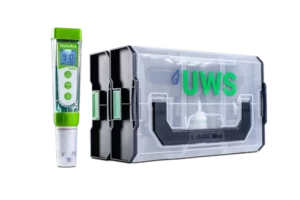
Messkoffer WaterBoy
The UWS WaterBoy measuring case contains everything the HVAC specialist needs to measure data in accordance with the VDI 2035, ÖNORM H 5195-1 and SWKI BT 102-01 standards in two L-BOXXES.To the product
This is followed by treatment.
Through targeted desalination, dissolved substances are removed and conductivity is reduced.
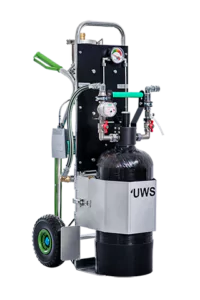
Heaty Ferriline No. 2
Complete unit for professional bypass treatment, sludge and magnetite filtration in the hot water area incl. MAGella twisterTo the product
Replenishment is then carried out in a controlled manner.
This is the only way to prevent unwanted substances from re-entering the system.
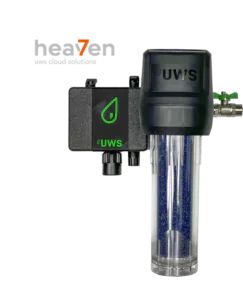
Heaty Complete Professional
Heaty Complete PROfessional is the world’s first smart IoT make-up system, including Cloud connection – fully automatic, leakage protection and digital water meter.To the product
Documentation ensures that changes remain traceable and trends are identified early on.
It is this interplay that ensures conductivity is not only reduced in the short term but maintained at a stable level over the long term.
Conclusion
Conductivity is far more than a technical measurement.
It is a key indicator of water quality—and at the same time an active driver of processes in the system.
A high value does not just mean “a lot of salt in the water,” but an increased risk of:
- Corrosion
- Deposits
- Malfunctions
The dynamics are particularly critical here:
Conductivity often rises unnoticed over long periods of time.
Understanding and consistently monitoring this parameter lays the foundation for stable and efficient system operation.
Or to put it another way:
👉 Conductivity not only indicates the condition of the water—it also plays a key role in determining how long a system will operate reliably.

 Contact us