


What happens if heating system water is not treated?
At first glance, everything seems normal.
The system is running, heat is delivered, and there are no error messages.
For many, this is where the consideration of system water ends.
However, heating system water is not a passive filling medium. It is an active component of the system and has a significant impact on how efficiently, safely, and reliably a system operates over time.
If it is not treated, processes occur in the background that develop gradually—and often only become visible once damage has already been done.
Scale: When heat transfer becomes a problem
One of the first effects of untreated heating water is the formation of scale deposits.
Drinking water contains dissolved hardness constituents such as calcium and magnesium. Under the conditions present in heating systems—especially at elevated temperatures—these substances precipitate and settle on heat transfer surfaces.
The key point:
These deposits do not form suddenly. They grow slowly and continuously.
With every additional hour of operation, the surface inside the heat generator changes. What was originally designed for optimal heat transfer becomes increasingly insulated.
Scale acts like insulation—at exactly the wrong moment.
The result is not a sudden failure, but a gradual loss of performance.
The system requires more energy to deliver the same heat output. At the same time, heat-up times increase and efficiency measurably declines.
Even a thin scale layer of just one millimeter can result in up to 15% performance loss—a factor that is often underestimated in practice.
Corrosion: Processes hidden from view
While scale primarily affects efficiency, corrosion directly attacks the substance of the system.
Here, too, the challenge lies less in the speed of the process and more in its invisibility.
Untreated heating water introduces dissolved salts and oxygen into the system—both key drivers of electrochemical reactions.
Conductivity increases, the water becomes more reactive, and conditions arise under which metals begin to dissolve.
These processes are not dramatic.
There is no immediate malfunction, no sudden failure.
Instead, the following develops over time:
- Material degradation of metallic components
- Localized corrosion, including pitting
- Gradual weakening of system components
What makes this particularly critical is that these processes often develop over years.
By the time they become visible, the damage is usually already well advanced.
Magnetite: When corrosion starts affecting system performance
Corrosion does not occur without by-products.
A typical result is magnetite — a fine, black iron oxide that spreads throughout the system.
This material is not neutral.
It tends to accumulate in areas where flow conditions, magnetic fields, or narrow cross-sections play a role.
This leads to new issues that are often not directly linked to the original cause:
- Pumps lose performance or fail
- Valves become sluggish or blocked
- Heat distribution becomes uneven
In practice, this often manifests as noise, cold heating surfaces, or generally unstable system behavior.
Magnetite is therefore not an isolated issue—it is a direct consequence of previously uncontrolled water quality.
The gradual effect: Why problems often go unnoticed
What all these processes have in common is their dynamic behavior.
They do not occur suddenly, but continuously—and that is exactly what makes them difficult to detect in everyday operation.
The system appears to be functioning.
There is no clear moment when something “breaks.”
Instead, operating conditions shift gradually:
- Efficiency decreases
- Components wear out faster
- Faults occur at longer intervals, but with increasing frequency
In many cases, action is only taken once the effects become clearly noticeable.
At that point, however, long-term damage has already occurred.
Top-up water: The often underestimated factor
One key aspect that is frequently underestimated is top-up water.
Even systems that are initially filled correctly do not remain stable over time.
Throughout the system’s lifecycle, new water repeatedly enters the heating circuit—whether through venting, maintenance, or even the smallest leaks.
With every top-up, new substances are introduced:
- Hardness constituents
- Dissolved salts
- Oxygen
This means:
Even initially good water quality deteriorates step by step without proper control.
This development is not sudden, but cumulative.
Over the years, the condition of the water becomes hardly comparable to the original filling.
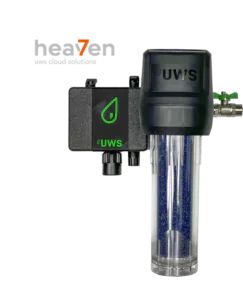
Heaty Complete Professional
Heaty Complete PROfessional is the world’s first smart IoT make-up system, including Cloud connection – fully automatic, leakage protection and digital water meter.To the product
System thinking instead of one-time measures
This is exactly why it is insufficient to consider water treatment as a one-time action.
It is not just about the initial filling—it is about maintaining long-term water quality stability during operation.
In practice, a structured approach has proven effective—what we call the UWS four-step principle.
It does not describe a single task, but a continuous operating concept.
It starts with measurement.
Only those who understand the current condition can make informed decisions.
Based on this, water treatment follows.
Undesirable substances are specifically removed to bring water quality into a stable range.
Equally important is controlled top-up.
This must also be treated to avoid reintroducing contaminants into the system. With systems such as our Heaty Complete PROfessional, this process can even be fully automated.
Finally, documentation ensures that changes remain traceable and developments can be identified at an early stage.
Only the interaction of these four steps ensures that water quality is not just improved temporarily, but kept stable over the long term.
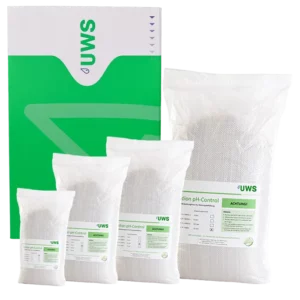
Mischbettharz Vadion pH Control
Our Vadion pH-Control is a mixed-bed resin that not only demineralizes the water to < 100 μS/cm (corresponding to 0–3 °dH), but also ensures that the pH value of the fill water remains within the required range.To the product
Conclusion
Untreated heating water is not a short-term risk—it is a long-term influencing factor that affects every system.
The effects do not appear immediately, but develop over time:
- Efficiency losses due to scale
- Material damage due to corrosion
- Functional issues caused by magnetite
Precisely because these processes occur in the background, they are often underestimated.
Yet this is exactly where the key lever lies.
Anyone who does not treat heating water as a one-time consideration, but keeps it under continuous control, creates the foundation for a stable, efficient, and economically viable system operation.
Or to put it another way:
👉 It is not the visible problem that determines the service life of a system—but what happens in the water.

 Contact us