


Essential for large-scale projects: Why heating water treatment must begin during the planning phase
Large-scale projects do not tolerate last-minute decisions.
As system volume, investment costs, and technical complexity increase, what may seem like minor details quickly become critical success factors. This is precisely where heating water treatment is often underestimated—or considered too late.
Yet the decisive course is set not during commissioning, but much earlier:
in the planning phase.
This is where it is determined whether water quality, system design, and operating concept are compatible—or whether problems such as corrosion, deposits, and efficiency losses will systematically accumulate later on.
In short:
If heating water treatment isn’t considered from the very beginning, risks are built into the plan.
Large-scale systems do not tolerate design flaws
While smaller heating systems can compensate for certain inaccuracies in water quality or operation for a certain period of time, large-scale systems react much more sensitively—and, above all, with longer-lasting consequences—to poor decisions.
The reason for this lies not in the technology itself, but in the scale and complexity of the overall system.
Large systems are characterized by:
- very large system volumes, where even small deviations affect large quantities
- long, branched piping networks with many potential weak points
- complex material combinations that promote electrochemical interactions
- high flow rates that distribute corrosion products throughout the system
- regular and often unavoidable makeup water during operation
In such systems, an unsuitable water management strategy does not have a localized or temporary effect, but rather a widespread and permanentone.
Corrosion products, magnetite, or unfavorable water parameters do not remain in one place but are continuously distributed throughout the entire circuit—with direct effects on heat exchangers, pumps, control valves, and distribution systems.
Errors in planning or in the water management concept can only be corrected later in large-scale systems at considerable expense. Retroactive measures are often expensive and difficult to implement operationally.
Therefore, the following applies:
The larger the system, the greater the impact of water quality.
What poses a risk in small systems quickly becomes a structural problem in large-scale plants—with direct consequences for the efficiency, operational safety, and service life of the entire plant.
Why “we’ll deal with it later” is too late
In many projects, the focus of early planning understandably lies on the visible and immediately performance-relevant components of the plant.
The main focus is usually on:
- the heat generator
- the distribution technology
- the control strategy
- the energy efficiency of the entire system
Heating water treatment , on the other hand, is often not considered until very late in the process—frequently just before commissioning and usually under considerable time pressure.
It is precisely at this point, however, that a technically important topic quickly becomes a mere checklist of requirements.
The central problem here:
By this point, essential, fundamental decisions have already been made:
- the pipe materials to be used have been determined
- the system volumes have been defined
- space in utility rooms is limited
- budgets have been allocated and distributed
This leaves little room for the thoughtful integration of heating water treatment.
Water treatment must be subordinated to existing conditions—rather than being meaningfully integrated into the overall concept from the outset.
The consequences often only become apparent later:
- Undersized treatment systems
- Limited maintenance and accessibility
- Improvised makeup water solutions
- Increasing operational costs
What could have been planned early on becomes expensive, complicated, and difficult to correct operationally in hindsight.
That is why, especially for larger projects, the following applies:
Heating water treatment is not an issue for the final project phase, but a fundamental planning decision.
Those who postpone it until “later” are unconsciously factoring in risks—technical, economic, and organizational.
Water quality influences planning and design
Even in the early planning phase, the future heating water quality has a direct and often underestimated influence on key design decisions for the entire system.
It is not a downstream operational factor, but a planning-relevant parameter that helps determine numerous technical details.
These include, among others:
- the choice of materials, such as the use of aluminum, steel, or stainless steel components
- the design of heat exchangers, particularly with regard to heat transfer and susceptibility to fouling
- the selection and sizing of corrosion protection concepts
- the necessary filtration and separation technology, for example for magnetite and suspended solids
- the makeup water concept, including treatment, monitoring, and protection
These points do not stand in isolation from one another, but are interrelated.
A specific material choice imposes requirements on pH and conductivity.
The selected water quality, in turn, determines whether additional protective measures are required or whether certain components are particularly sensitive.
If this relationship is not taken into account during planning, conflicting objectives arise that are difficult to resolve later on.
Typical consequences are:
- Retrofitting of additional technology
- Limited maintenance and accessibility
- Higher investment and operating costs
- Compromise solutions that leave long-term risks in the system
This is particularly evident in larger systems:
Defining water quality early on and tailoring it to the system is a prerequisite for clean, consistent, and reliable planning.
What is not considered here can usually only be corrected during operation with considerable effort.
Make-up water: the silent, constant factor in large-scale projects
Large-scale systems are not filled once and then left to their own.
They are operated over years and decades —and are regularly replenished during this time.
Replenishment is therefore not an exception, but a constant companion of plant operation.
Simply through:
- Ventilation processes during operation
- Maintenance and service work
- Plant expansions or modifications
- Tiny, often unnoticed leaks
new water repeatedly enters the heating circuit.
Every single top-off alters the water chemistry.
Salts, hardness components, and dissolved gases are introduced anew; conductivity rises gradually, and existing equilibria in the system shift.
These changes do not occur abruptly, but rather cumulatively —over many years.
Without a planned and controlled makeup water strategy, this inevitably leads to:
- a gradual deterioration in heating water quality
- rising conductivity and increased electrochemical activity
- increasing risks of corrosion and magnetite formation
What is particularly critical is that these processes often go unnoticed in day-to-day operations.
The system appears to continue functioning reliably—while the conditions for future damage are already building up inside.
However, this long-term factor is frequently underestimated or completely overlooked during planning.
Water replenishment is viewed as a purely operational process, not as a planning-relevant factor influencing water quality, corrosion protection, and the system’s service life.
This is why, especially in large-scale projects:
If you don’t plan for makeup water from the start, you’re planning for long-term risks.
A well-thought-out makeup water concept is not an add-on, but a fundamental prerequisite for stable water quality and sustainable plant operation.
Treatment as part of the technical infrastructure
In professionally planned large-scale projects, heating water treatment is neither a retrofitted accessory nor an optional add-on component.
It is an integral part of the technical infrastructure —comparable to pumps, control systems, or safety devices.
In concrete terms, this means:
Heating water treatment is not viewed as a standalone measure, but rather as:
- an integral part of the entire plant engineering
- a clearly defined and permanently effective process
- a continuous protective measure for all water-carrying components
To meet this requirement, the treatment system must be properly designed and planned from the very beginning.
This includes, in particular:
- adequately sized treatment systems that cover not only the initial filling but also ongoing operation and makeup
- a clear hydraulic integration so that treatment and makeup can be performed in a reproducible, controlled manner without bypasses
- easy-to-maintain accessibility to enable inspection, service, and media changes without operational risks
- Defined measurement and documentation points at which water quality can be checked, evaluated, and documented in a traceable manner
Only when these points come together does heating water treatment become a manageable, predictable, and long-term effective process.
If, on the other hand, it is viewed merely as an afterthought, a permanent risk arises—technically, economically, and organizationally.
This is particularly evident in large-scale projects:
Heating water treatment is not an additional function, but a fundamental infrastructure decision.
Cost-effectiveness begins before commissioning
A common argument against considering heating water treatment early on is:
“That incurs additional costs.”
However, this view is too narrow.
It focuses exclusively on the investment phase—not on subsequent operation.
In reality, it has been shown time and again: Lack of or inadequate planning leads to significantly higher costs in the long term.
Those who consider heating water treatment too late or only in a rudimentary way risk, among other things:
- increased maintenance and service costs due to unstable water quality
- premature wear of heat exchangers, pumps, and control valves
- gradual efficiency losses with permanently higher energy consumption
- Complaints and unplanned repairs
- Liability and warranty issues in the event of damage
These costs do not arise all at once, but accumulate over the years—often unnoticed, yet continuously.
Heating water treatment that is planned early and seamlessly integrated counteracts this very issue.
It ensures that the system is operated under stable, controlled conditions from the very beginning.
The result:
- Lower ongoing operating costs
- Longer service life of key components
- Minimized downtime and predictable maintenance intervals
- Greater investment and operational security over the entire lifecycle
This is particularly evident in large-scale plants:
Cost-effectiveness is not the result of individual commissioning decisions, but rather the result of forward-looking planning.
Investing early reduces long-term costs—and creates a solid foundation for stable and cost-effective plant operation.
Clearly define responsibilities rather than discuss them later
Especially in large-scale projects with many stakeholders, a clear allocation of responsibilities is a decisive factor for success.
Planners, contractors, operators, and, if applicable, external service providers work on different parts of the same system—often at different times.
If heating water treatment is planned early on and consistently documented, it is possible to:
- clearly and transparently separate responsibilities
- Technical and organizational interfaces can be clearly defined
- Unambiguously document the system’s status at specific points in time
This makes it clear:
- who was responsible for the design and planning
- the condition in which the system was handed over
- what measures were taken during ongoing operations
Without this clarity, disputes can quickly arise in the event of damage:
- Did the water quality deteriorate only during operation?
- Was the system replenished correctly?
- Were maintenance and inspection requirements met?
Without proper documentation, these questions can hardly be answered with any certainty.
Heating water treatment that is planned and documented early on therefore reduces not only technical risks but also legal uncertainties during subsequent operation.
It creates transparency, protects all parties involved, and prevents technical problems from turning into protracted liability disputes.
This is especially true for large-scale projects:
Clear processes and verifiable records are just as important as the technology itself.
Holistic planning instead of retroactive repairs
As with all UWS Technologie concepts, practical experience in the large-scale plant sector demonstrates:
Heating water treatment works best when it is considered from the very beginning .
Not as a reaction to damage, but as a preventive component of modern plant technology.
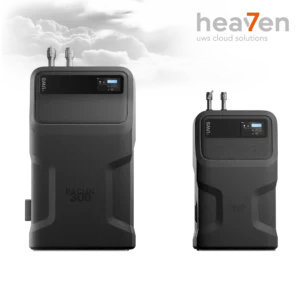
Racun 100 / 300
The Racun series comprises water treatment systems that reliably ensure consistently stable water quality, even in complex and highly sensitive facilities. Wherever system failures can have serious consequences – in industrial plants, hospitals, local heating networks or data centres – Racun offers a level of reliability that sets new standards.To the product
Conclusion: In large-scale projects, heating water quality is now a priority
Large-scale projects do not need improvised solutions.
They require well-thought-out concepts that function for decades.
Heating water treatment:
- affects efficiency and service life
- protects investments
- reduces operating costs
- provides planning security
If you only consider it at the end, you’re taking a risk.
Those who integrate it from the start are planning for the long term.

 Contact us